
- Sparx Science
Our key findings from the 2026 Examiner Reports
 Dan Gosselin|November 02, 2026
Last year we shared our key themes from the 2025 Examiner Reports, and reading this year’s Examiner Reports, there were plenty of familiar messages. Students still found explanations challenging, practical methods needed more detail, and scientific language sometimes got in the way of showing what they knew.
In part one of this blog post, I'll summarise the key themes of this year's reports.
1. Students could gain more marks by using command words to guide them.
Examiner reports continue to stress the value of understanding command words. As we covered last year, many students did not do enough when they were asked to explain their answers. And that could be preventing them from getting a lot of marks. For higher-tier students, these questions make up 27% of available marks in AQA and 22% in Edexcel.
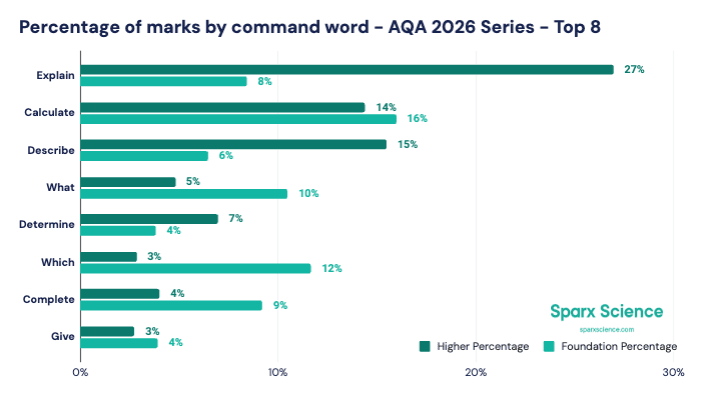
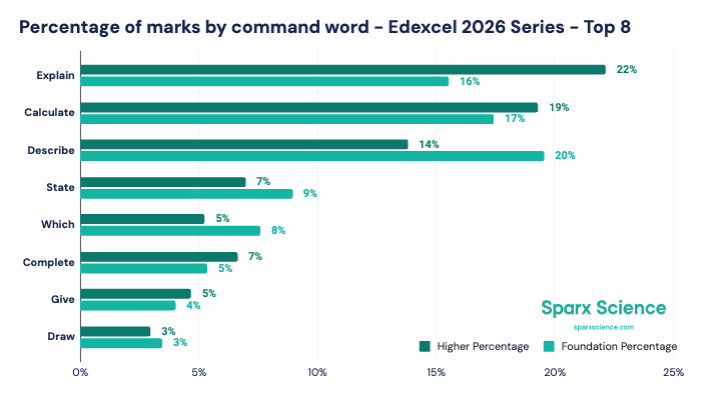
Across both boards, examiners described answers that gave a valid observation but stopped short of a mechanism or consequence. Given how many marks these questions make up, explain questions are a specific skill that is worth developing with your students. To get top marks, students should check for a Reason and Result in their answer, with that result tied to the context of the question.
Comparisons also cause students to lose relatively simple marks. Students often correctly identify the two points of comparison, but stop short of actually comparing them, using phrases such as greater or slower. In evaluations, students made similar mistakes and rarely gave a holistic judgement. One key piece of advice the examiners give here is that students they need to add value to the data they have been provided.
Command words can also help reduce student workload. In one Edexcel question students were asked to state a value; this should have implied that there was no calculation needed. Yet many students still attempted a calculation that often led them to the wrong answer. Here, interpreting the command word correctly could save time and increase the chances of a correct answer.
2. Small mistakes cause lost marks in more complex calculations.
Across the reports, students often found the relationship they needed, but lost marks when they had to convert a unit, find an intermediate value or use a result in a second step.
Embedding the process for this with students early and sticking to it in every lesson helps them make sure they do not miss these simple steps in exams. Before substituting numbers, students should check for conversions, and afterwards, they can check whether the answer’s size and unit make sense.
Less prevalent mistakes include rounding during calculations, treating significant figures as decimal places, manipulating powers of ten, and interpreting a squared or cubed unit as an instruction to square or cube the unit being converted.
3. A practical method must produce a result (safely)
Practical design and measurement are mentioned in examiner notes from almost every paper. Students could often name apparatus or a technique, but did not always say what to measure or how the readings would give the result. Students should remember to:
- describe how the independent variable will be changed;
- name the apparatus and the quantity they will measure;
- describe how readings will be recorded;
- and explain how the readings will be processed or compared.
One common mistake students make is to use statements such as ‘measure the resistance’, or ‘increase the temperature’. Whilst I expect many of these students know the equipment and method needed here, they have not ensured this is clear.
In risk assessments, students did not always distinguish between hazards, risks and control measures, or give the correct precaution for the stated risk, ofen using phrases such as ‘be careful’, ‘wear goggles’ or ‘wear gloves’ (I look at this in data in our next post!).
4. Subject-specific language, definitions and conventions
Once again, students experienced a range of challenges in specific areas of the specification. It’s important to remember that these issues relate to this particular exam series, but as with last year, here’s a whistle-stop tour of the key language issues and misconceptions.
- In Biology: students should use ‘electrical impulse’ rather than simply ‘message’ or ‘signal’, describe an iodine-test result as ‘blue - black’ (not blue/black, which implies either colour); distinguish an allele from a gene; refer to blood-vessel walls, not cell walls; write ‘large lumen’, not ‘large surface area’, when describing a vein; and say bacteria are killed or destroyed, while enzymes are denatured.
- In Chemistry: students should write ‘water’, not ‘hydrogen oxide’ or ‘hydroxide’; distinguish ammonium from ammonia in compound names; distinguish colourless from clear; use a subscript in O₂ rather than writing O=O or O²⁻; use ‘inert’ or ‘unreactive’, not ‘low reactivity’; distinguish acid strength from acid concentration; and know an ionic substance conducts when its charged ions are free to move - not merely because ions are present.
- In Physics: students should know that radioactive nuclei or materials decay and emit radiation - the radiation itself does not decay; know that acceleration and deceleration are the same type of quantity; distinguish constant velocity from being stationary; distinguish mass, volume and density during a change of state; and clearly state that electromagnets require an iron core.
In my next blog, I will look in detail at some of the most challenging questions this year alongside our own data from similar questions in our content bank - stay tuned!