

- Sparx Science
Your shortcut to the 2025 Science Examiner Reports
 Dan Gosselin|October 14, 2025
As a former Head of Department (HoD), I remember poring over Examiner Reports, trying to spot small insights that I could integrate into lessons to give students the best chances of exam success, knowing that it can sometimes come down to those one to two marks for the difference between a 7 and an 8.
With 24 science reports for each exam board at GCSE alone, it often meant hours of reading that teachers across the country were all repeating. We wanted to lighten that load. So I read all 48 examiner reports - 24 from AQA and 24 from Edexcel - more than 2,300 pages - to build a picture of the challenges students face. I shared this insight in a 10 minute In Brief session with schools at the start of the year, and we also used the findings to refine how we use Sparx Science content to better support teachers and students.
Anyone who has read examiner reports will know that whilst they are incredibly valuable, they are also quite overwhelming. We've summarised the key themes below and we hope they’re helpful as you think about the support your students might need.
Command word confusion
In something that will likely not be a surprise to many science teachers, one of the significant challenges students face is distinguishing between key command words.
- Explain vs. Describe: Students often describe what is happening when the question requires them to explain why it happens. For example, they may give an outcome of an experiment without offering the scientific reasoning behind it.
- Compare: When asked to compare, students often list two separate descriptions, without making the explicit comparison e.g., describing values rather than using comparative language such as "lower" or "faster than".
- Evaluate: Students compare data points without considering the consequential strengths or limitations of the information presented.
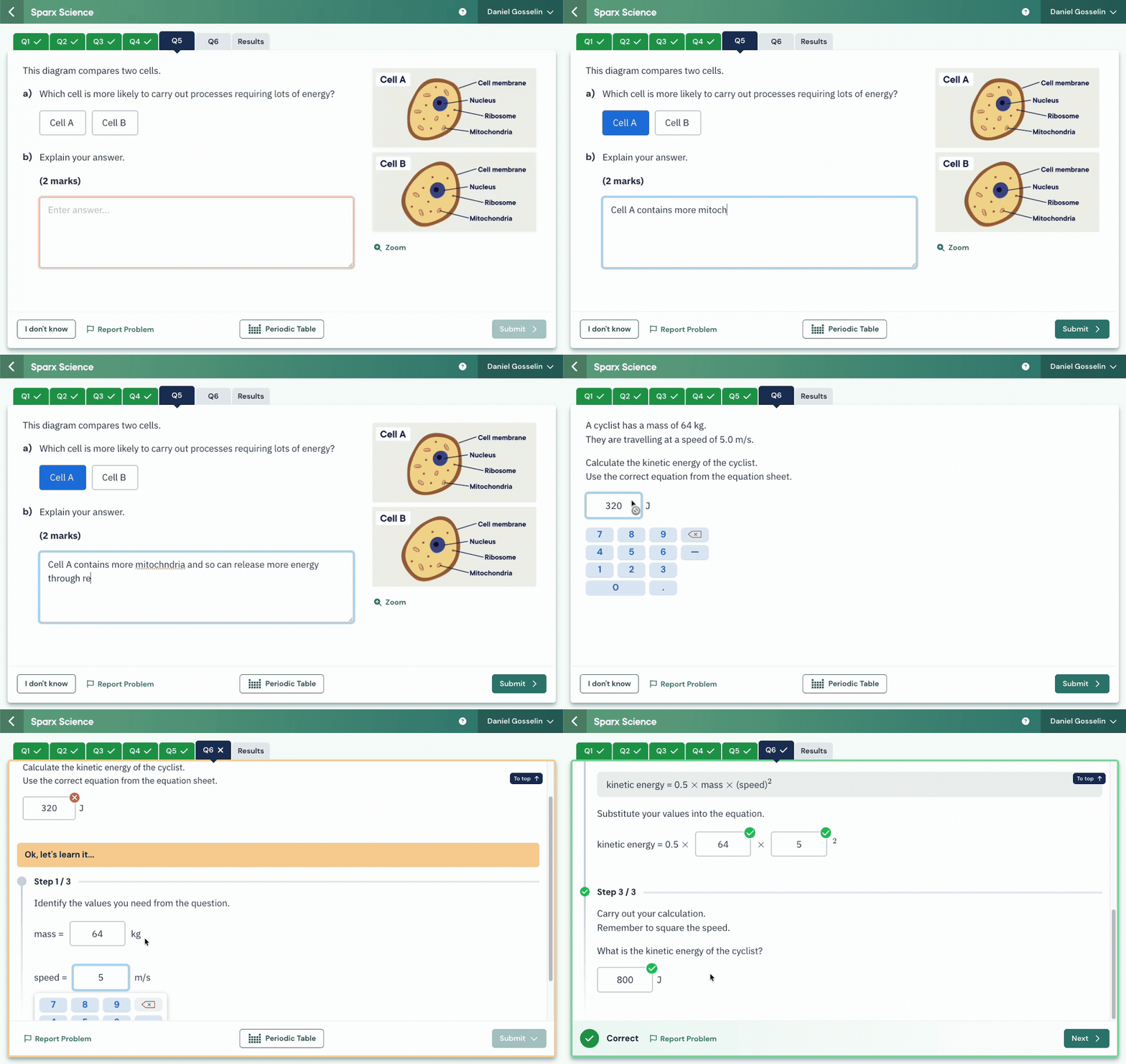
A key to this for students is regular, varied practice. Rosenshine highlights the importance of independent practice as a way to over learn a skill. When I was HoD, we began talking explicitly about how to respond to command words from Year 7, recognising how early, consistent exposure helps students build strong habits. When we designed Sparx Science, we wanted to give students meaningful practice with command words, and developed our automatically marked short answer questions to help students build confidence through real-time feedback on their performance and break down the question-specific steps in the support.
Alongside this the reports highlight some simple but common issues, including:
- Not following specific instructions, such as 'write one tick per row' or 'tick two boxes'.
- Missing prompts that require them to draw their answer on a figure.
- Copying or paraphrasing information provided in the question.
The challenge of practical skills
Describing and critiquing practical work remains a significant hurdle. Some of the most common areas where students need support include:
- Writing methods: Students may outline a general method but miss the key steps needed for it to be workable. For example, they might write "find the change in length" without describing how (i.e., measure initial length, apply force, measure final length, and subtract).
- Suggesting improvements: Responses are often too vague. A common example is "repeat the investigation" without explaining how this improves reliability (e.g., "to calculate a mean and identify anomalies").
- Safety and variables: Students struggle to identify context-specific safety precautions, offering generic answers like “wear PPE”. They also frequently confuse control variables with the independent or dependent variables.
- Trends and patterns: Students can identify basic trends, but often need support in providing fuller descriptions that include specific data points, turning points, or the non-linear nature of a relationship. Students often also forget to link these to the scientific context.
- Terminology: Terms such as resolution, accuracy, precision and repeatability are commonly confused.
We’ve created context-light, practical skill-focused tasks through our Working Scientifically topics. They’ve been designed to ensure students build the skills, instead of just learning the outcome. They’re flexible so they can be placed anywhere in your curriculum to help students develop understanding that can be transferred.
Errors in specific subject content
Students experienced a range of challenges in specific areas highlighted in the reports. It’s important to remember that these issues relate to this particular exam series, so they shouldn’t prompt major changes to your classroom practice. However we always review these points to ensure we are providing students with the volume and variety of practice they need to succeed in science.
Language, definitions and conventions
Across biology, chemistry and physics, students regularly encountered challenges with terminology.
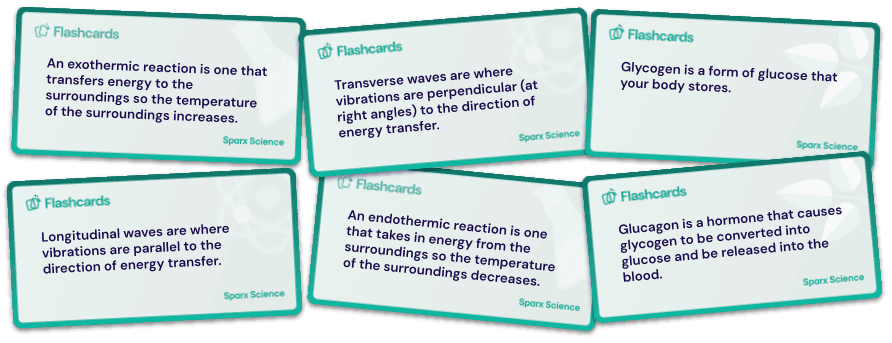
In biology there was confusion between crucial pairs, such as: antigens and antibodies; glucagon, glycogen, and glucose; breathing and respiration; and diffusion and osmosis.
In chemistry, students made errors in chemical formulae, including incorrect or unclear use of subscript and superscript numbers, and confused exothermic and endothermic reactions and the Halogens and halides.
In physics, students confused mass and weight; irradiation and contamination; and transverse and longitudinal waves
Our new Flashcards feature is designed to support high-repetition practice of factual knowledge, learn more in this blog.
Topic-specific weaknesses
Examiner Reports inevitably surface topics where students struggled. While they can point to specific areas of weakness, it can be difficult to separate these from the context in the exam series itself. With such a large volume of content to assess some topics may only appear once in a paper, and if that happens to be question 7 part 5, it’s far more likely that students will find it challenging. For this reason, we don’t recommend allocating extra classroom practice to these specific areas.
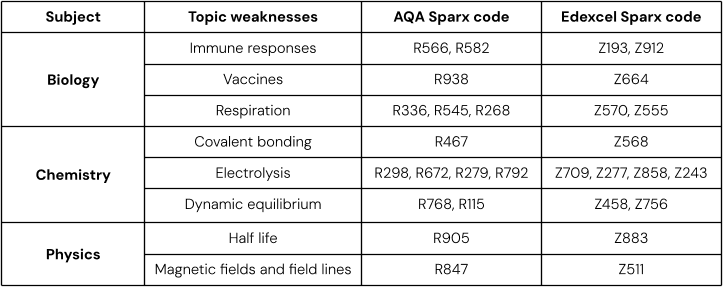
With that sizeable, heart-endangering pinch of salt, below are the topics students found most this year, along with the codes students can use to practice these on Sparx Science.
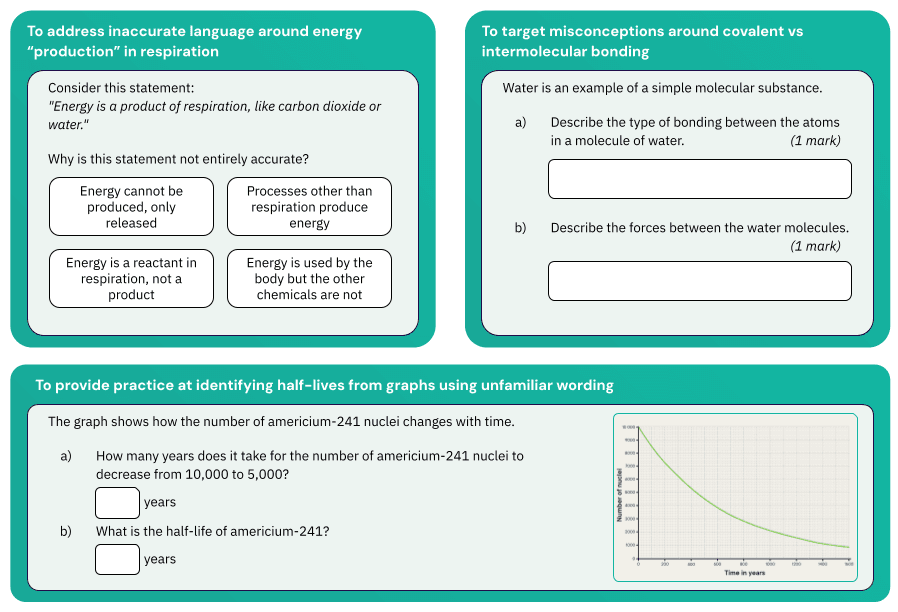
With almost 30,000 questions in Sparx Science, there is already plenty of practice on topics from across the whole specification. We review our content every single day, but following this exam series we prioritised the topics above to ensure students receive varied and robust practice that targets known misconceptions. Below are some example questions we offer to address misconceptions from this year's papers.
We hope that these insights offer a useful starting point for conversations within your team as you plan to support your students this year.