

- Sparx Science
Flashcards and Retrieval practice
 Dan Gosselin- Lead Secondary Science Advisor|November 03, 2025
The challenge of the science curriculum.
I hear it a lot. The science curriculum is knowledge-heavy.
It’s true. Teachers know it instinctively. There’s no room to slow down without risking a squeeze at the end of the year, sending students home to learn the uses of different waves in the electromagnetic spectrum, or having to cover content in less depth than is ideal.
On top of that, it is also knowledge-diverse. Students don’t only need to know what specific heat capacity is, they need to know how to calculate it, and how to measure it. “Calculate it” involves a range of mathematical skills to manipulate equations, and “measure it” means knowing experimental methods and how to execute them, how to read a thermometer, and how to do so safely.
With such volume and variety of knowledge, how can we be most effective in ensuring our students succeed in science?
According to cognitive scientist Daniel Willingham, the thing that underpins students' ability to think deeply about science is a strong foundation of background knowledge, stored in their long-term memories. This is crucial for making sense of new information and for expanding an existing schema - building more and stronger connections between diverse scientific ideas.
Therefore, one of the best ways to support students with the volume of information they encounter as we power through the five-year secondary curriculum is to do all we can to help them embed a strong knowledge base from which more complex ideas can develop.
Not all knowledge is created equal.
So, back to my original point - the science curriculum is knowledge-heavy. Our instinct tells us this is true, but at Sparx, we set out to quantify the volume and variety of the curriculum. We’ve pored over GCSE specifications, assessment material and the national curriculum to better understand all of the knowledge students actually need to know to succeed in secondary science.
This is no mean feat. Specification points can be vague, some exam series raise knowledge inferred but not stated in the specification, and where gaps exist, schools can choose to cover concepts differently.
To measure the diversity of knowledge, we looked to the work of Anderson and Krathwohl (2001), in A Taxonomy for Learning, Teaching and Assessing. Here, they define four “knowledge dimensions” for different types of knowledge. For the curriculum, we didn’t analyse the metacognitive side of knowledge, leaving us with three categories:
- Factual knowledge is the terminology, conventions and (as the name suggests) underlying facts of the subject. This could be the names of parts of the cell, relative atomic masses of subatomic particles or the make-up of types of radiation.
- Conceptual knowledge is a more complex knowledge form. It includes theories, processes and the interrelationship of many facts to form more complex schemas. For example, many facts about the atom come together to form the concept of the atomic model.
- Procedural knowledge is the “how-tos” - the algorithms and procedures that need solving or doing. This encompasses the mathematical requirements for science, as well as experimental methods.
Analysing the whole of the secondary science curriculums across different exam boards, we identified 2479 knowledge statements in AQA GCSE alone. This highlights just how knowledge-heavy the curriculum is.
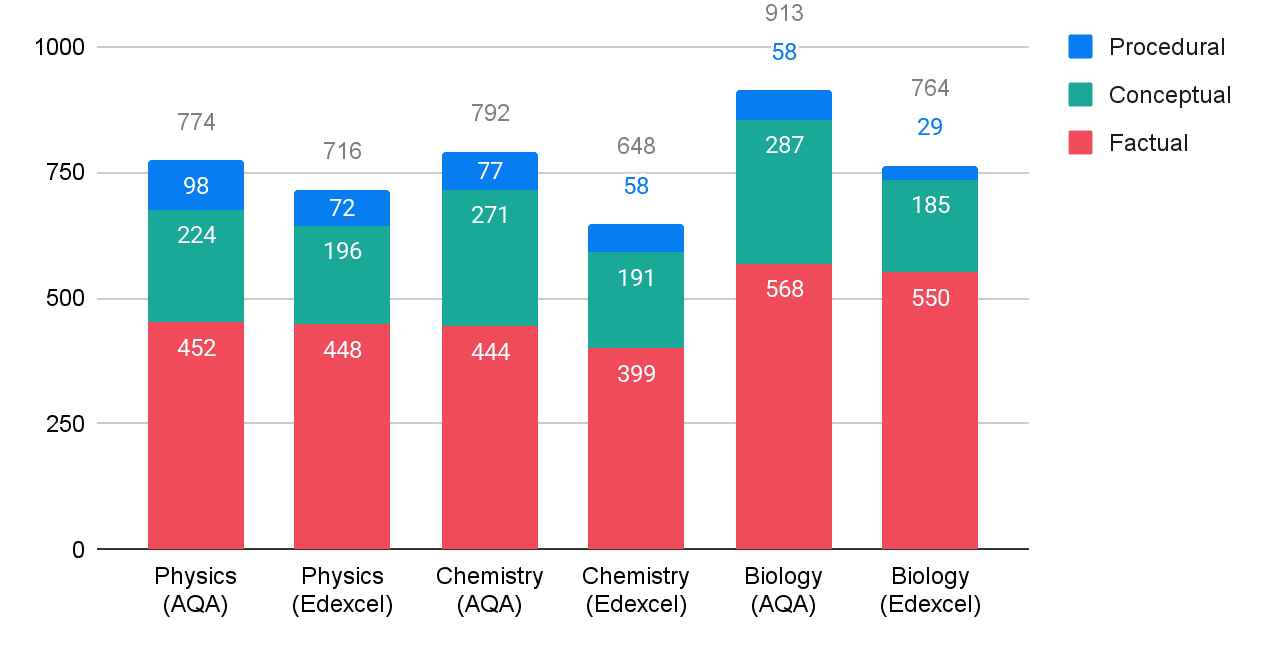
So what do I mean when I say not all knowledge is equal? It’s clear that the majority of statements in the curriculum are factual. But this doesn’t mean that we spend the majority of our time on teaching these; in fact, we likely spend more time focusing on connecting these ideas and practising procedural skills. To be most effective, we need to consider our approach to each knowledge category differently.
Knowledge needles in a haystack.
Factual knowledge is key to a student’s success, however it doesn’t live in a vacuum. If new factual knowledge is unconnected and poorly organised, then as the “haystack” of knowledge builds, it will become harder to retrieve specific factual knowledge.
We must therefore leverage conceptual and procedural knowledge alongside factual knowledge to build meaningful and deep links between concepts. Pritesh Raichura writes about methods we can use in classrooms to do this, so it’s well worth exploring for further ideas.
Back to our journey here - Sparx Science already offered a variety of practice types to support with the diversity of knowledge, but we wanted to focus on the most voluminous knowledge category - factual knowledge. There wasn’t a need to reinvent the wheel, flashcards have long been an effective way to do this, but we wanted to refine it to reduce friction and maximise efficiency (spoken like a true former physics teacher).
We took the principles of effective flashcards and supercharged them using research embedded in cognitive science and effective retrieval practice, aiming to create practice that was:
- Targeted: Focused on the core factual knowledge that underpins deeper understanding.
- Meaningful: Students need to engage with the knowledge to complete their flashcard task.
- Quick: Designed for high-repetition practice.
- Timely: Surfaces knowledge which aligns with recent teaching, whilst revisiting previous learning.
Our new Flashcard practice doesn't just give your students the tools to build their core knowledge; it ensures they engage with the whole of the knowledge statement, not just the answer. If a student gets a question wrong, we don’t just show them the correct answer; we show the relevant knowledge statement.
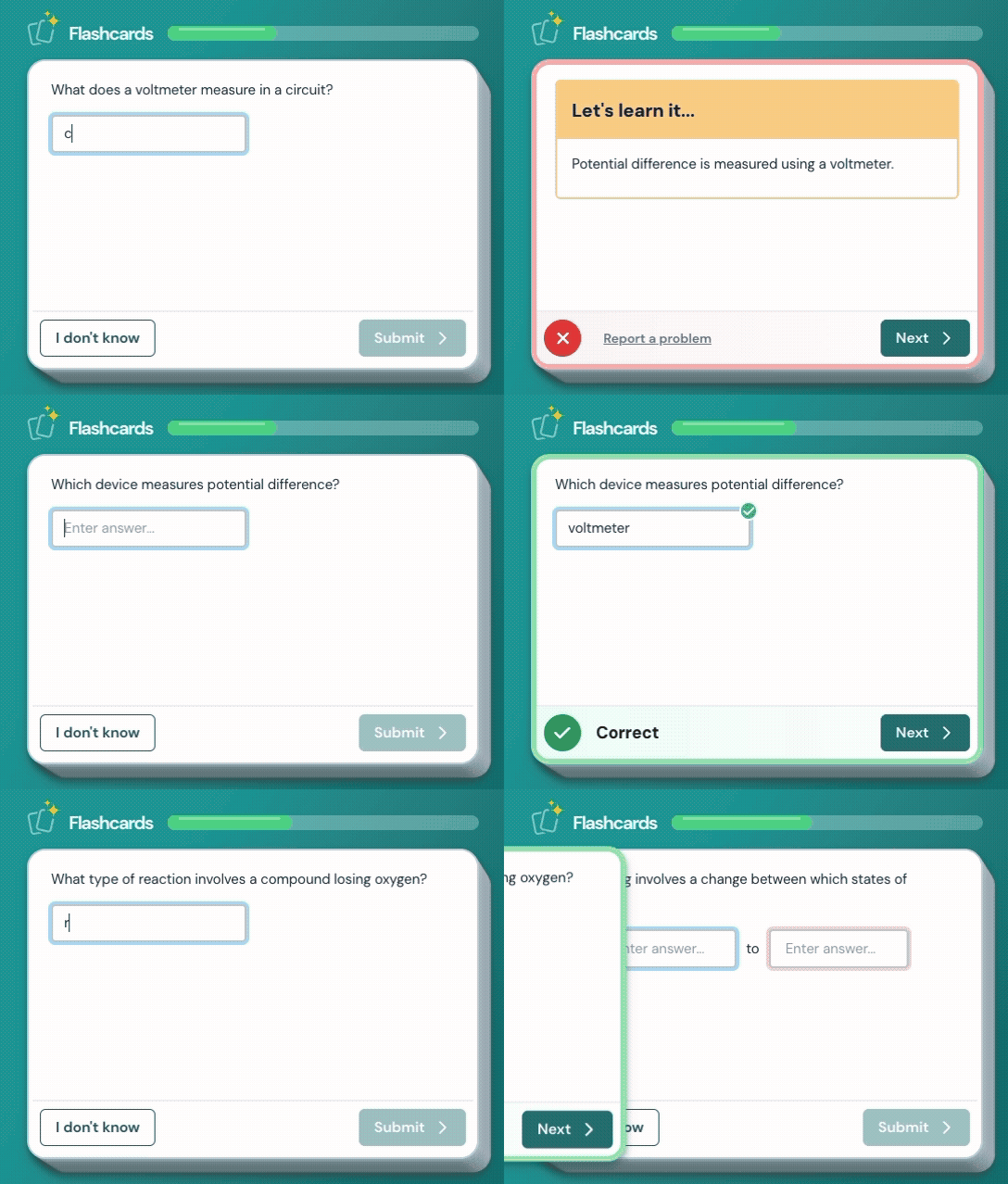
Rapid retrieval through flashcards allows us to provide meaningful practice for core factual knowledge, complementing the deeper understanding developed by the questions in our wider content bank.
Greater knowledge insights
In science, the variety of knowledge and the new scientific contexts can make it difficult to identify the exact challenges students face. Is the barrier the question context, the factual knowledge, or the procedural skill? With flashcards, we have worked hard to ensure the questions focus on just testing the factual knowledge.
Because all students see the same flashcard content, each targeted to a single knowledge statement, we can meaningfully analyse data from across the country to understand which factual knowledge students struggle with the most and identify common pitfalls.
For example, when practising atomic structure, we see the knowledge statement students most struggle with is: “In an atom, the number of electrons is equal to the number of protons in the nucleus”. We can even dig into the answer data to understand what misconceptions students have. In this case, many students believe the numbers of protons and neutrons are equal. Learn more about this in our poster about factual confidence in atomic structure.
As students continue to use this feature, we'll keep learning and finding new ways to surface these insights to you. We're excited to share what we learn because we believe this data can help all of us better support every student.