

- Sparx Science
Challenging questions in 2026 - What we can learn from our data
 Dan Gosselin|November 02, 2026
The first post in this series explored where students lost marks in the 2026 AQA and Edexcel science exams. In this post, we look at responses to similar questions in Sparx Science to better understand which steps students found challenging.
Can students explain the idea they recognise?
Fewer than 1% of higher tier students gained full marks explaining why large multicellular organisms need transport systems. Many mentioned surface-area-to-volume ratio, without linking it to diffusion distance and supplying cells.
A Sparx Science question approaches the principle from the other direction: thin flatworms do not need specialised exchange surfaces. In the first part, 79% of recorded answers correctly identify that conclusion.
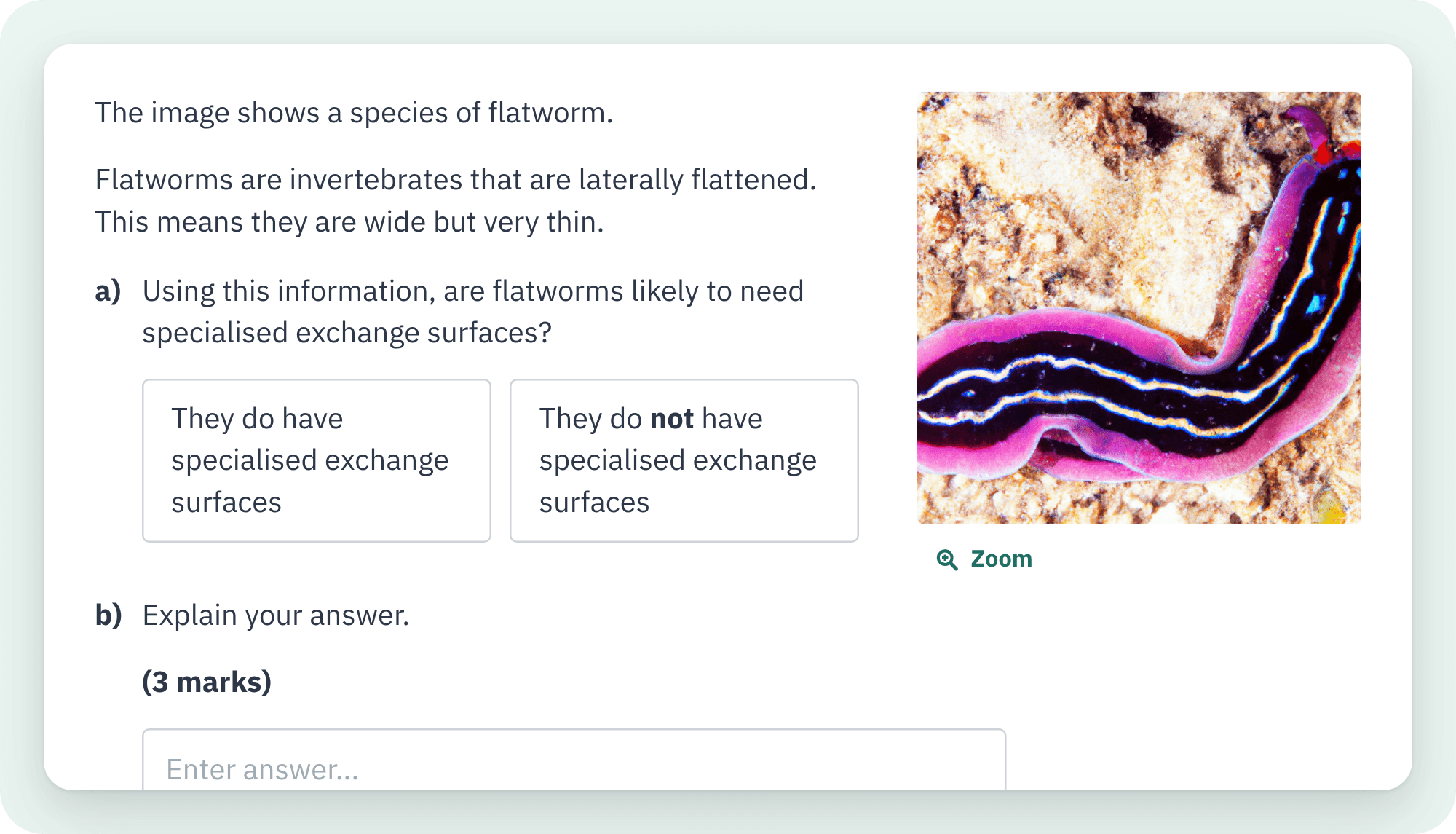
The following written part gives us more detail. Only 26.7% of students' first responses gained full marks (in Sparx Science we let them reattempt an answer if they get it wrong and provide some hints towards the correct answer).
Looking a bit deeper - 72.3% of students, and almost all answers that gained any marks, make reference to SA:V ratio or the cells being near the surface, but they struggle to then link this to having a short diffusion distance and the importance of diffusion to cells. The most common second mark comes from the student stating that diffusion can meet the cells' needs (40.9% of first responses include both these); fewer successfully link this to the shorter diffusion distance (37.0% include both of these).
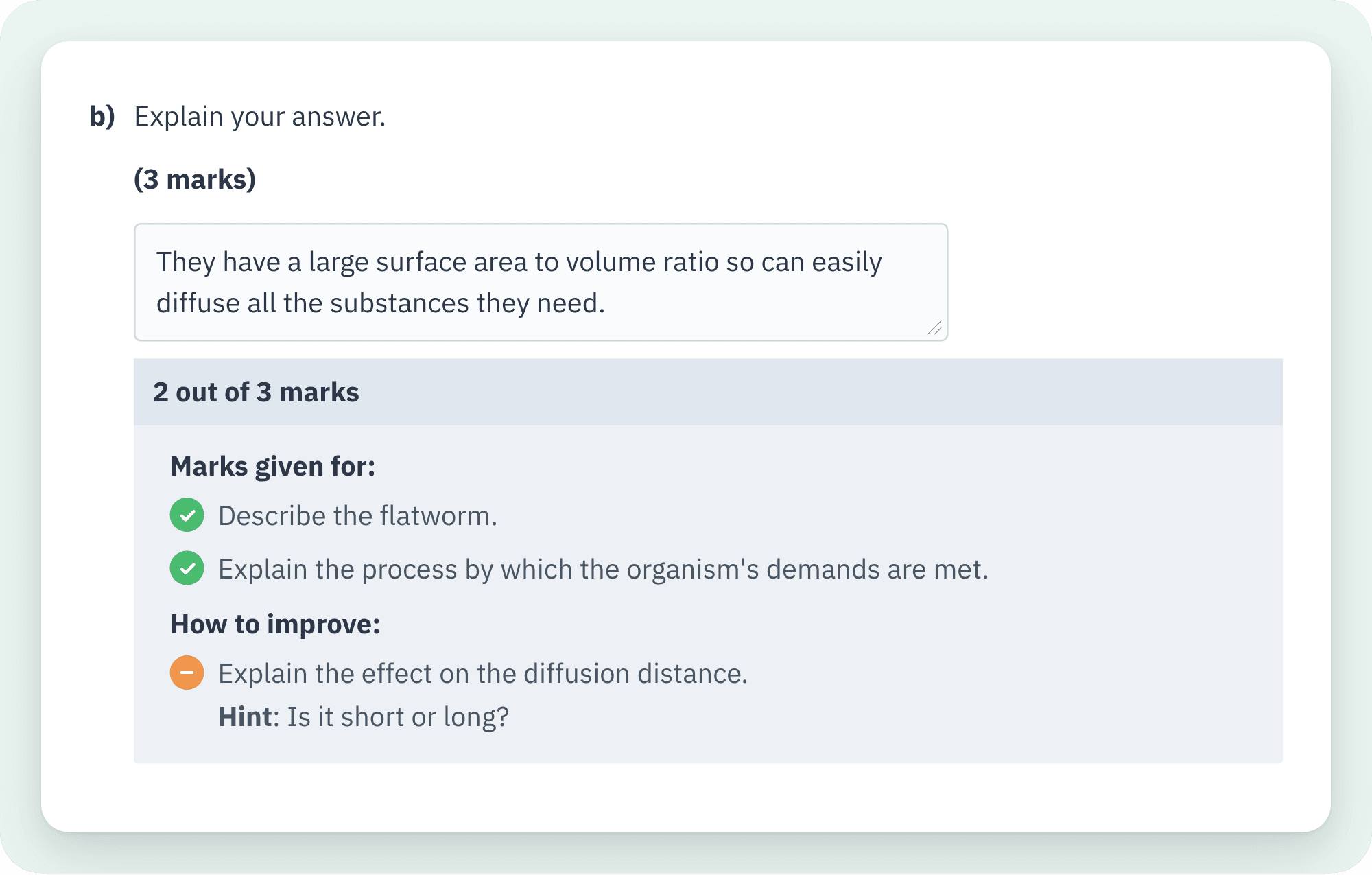
With prompting in Sparx Science, 44.8% of students who did not get full marks were able to add at least one of their missing points - particularly around diffusion distance. Once again, this highlights that students do not always include the appropriate level of detail in explanation answers, but have the knowledge they need to do so.
Does the method include the necessary readings?
AQA asked students how to measure the mass and volume of a crushed aluminium can. Whilst most were able to give a clear method to measure mass, fewer gave a good description of volume. Many knew displacement was relevant, but left out readings or measuring equipment needed.
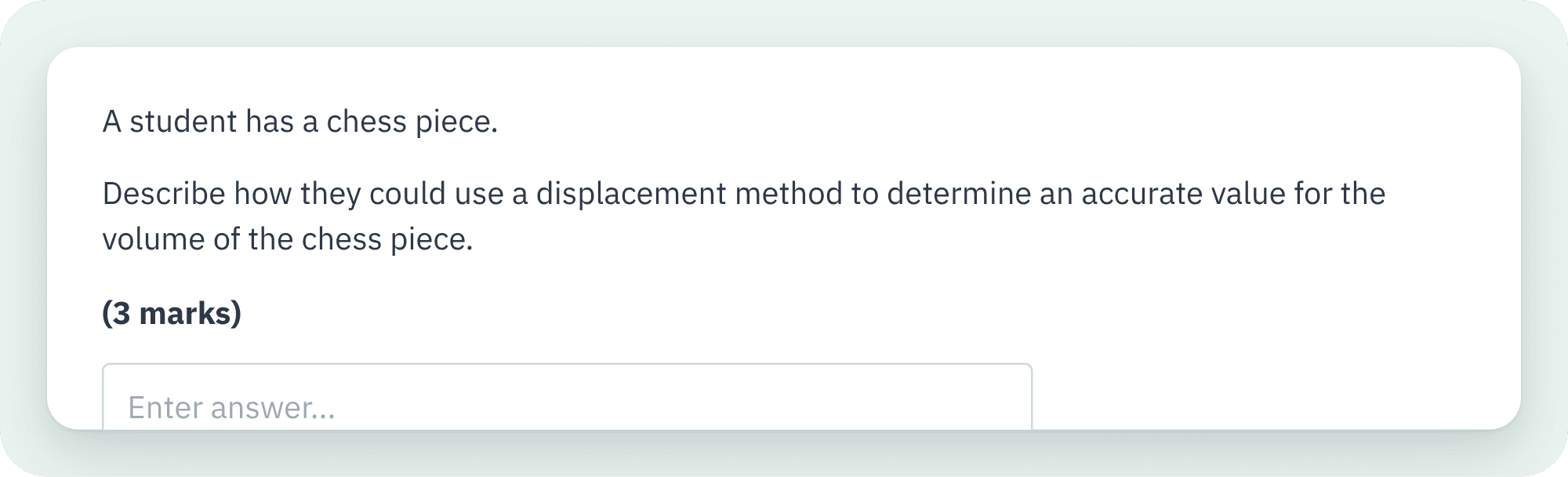
In a linked Sparx Science question, students are told to use displacement to find the volume of a chess piece. Only 42.9% of the 20,519 recorded first responses were marked as fully correct. Answers such as ‘Use eureka can’ and ‘Measure displaced water’ are common starting points, but are not complete enough to earn full marks.
Most notably, 11.0% of first responses gained the first two marks, but did not include the final explicit volume calculation or statement. Conversely, 10.8% of first responses only stated that students should work out the difference without giving a clear method. This mirrors what the examiner reports say about students missing the key final steps of methods, or not giving clear indications of the procedure.
Can students turn a risk into a suitable control measure?
In a question about identifying control measures, only about 2% gained both marks for completing a risk assessment. Examiners wanted the precautions specifically for the risk of microorganisms being transferred from the used swab and a control after collection, so expected responses such as ‘disinfecting the swab’ or ‘sealing it in a bag’. Many defaulted to basic precautions such as ‘wear gloves’ or ‘wear goggles’, which were not appropriate in this question.
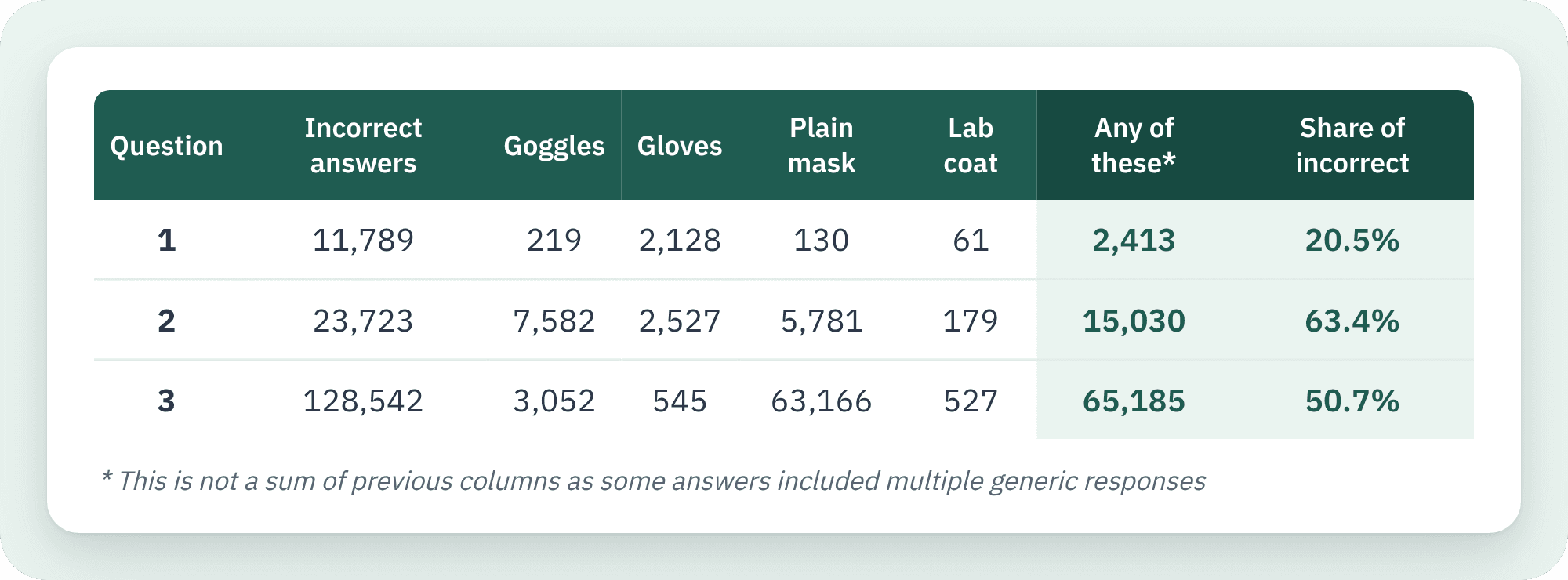
We have a number of similar questions where we ask students to suggest a suitable precaution based on a given risk.
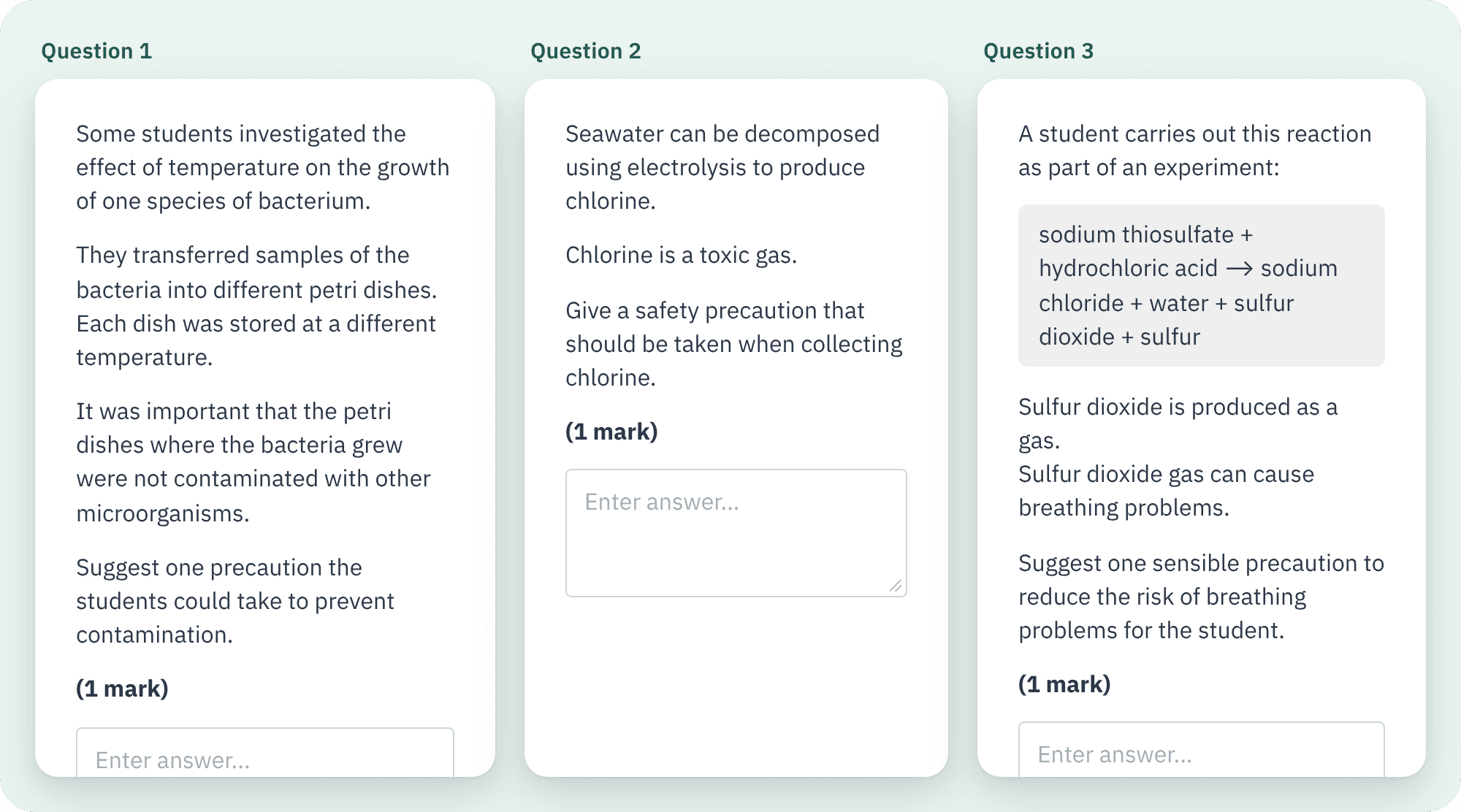
In all of these questions, the students are expected to give specific precautions; however, many students default to generic answers. In fact, in questions 2 and 3 where the expected answer is to use a fume cupboard, many responses only give generic safety measures (gas mask would be acceptable), making up over half of the incorrect answers provided.
What does “denatured” explain?
In both AQA and Edexcel papers, students struggled to answer questions about enzyme denaturing and specificity. Students made common errors using phrases such as ‘it changes shape’ without a clear referent, or lock-and-key statements that were not connected to the question. They also did not clearly take guidance from Explain - in one question students simply described the data in the graph without giving a clear reason why.
We have a question that covers similar marking points in Sparx Science.
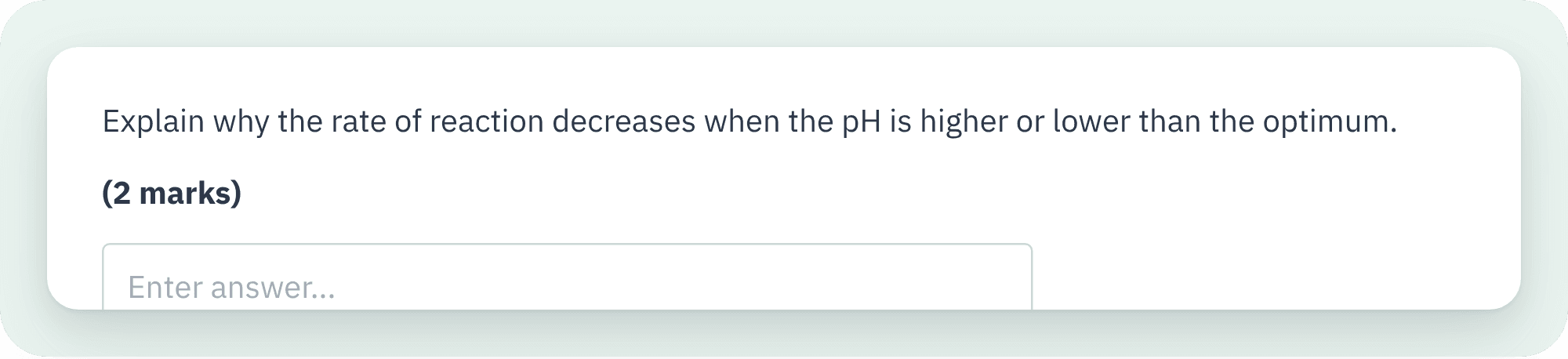
43.8% of first responses were marked fully correct. 36.5% of first responses matched the common answer to the exam questions - giving answers like ‘the enzyme denatures’, but did not provide the explanation that this means the substrate cannot bind. A common approach in these answers is to state ‘therefore the rate of reaction decreases’, however as this is given in the question, the students also need to provide the consequence.
An additional point for the same question in the AQA paper was to mention specificity.
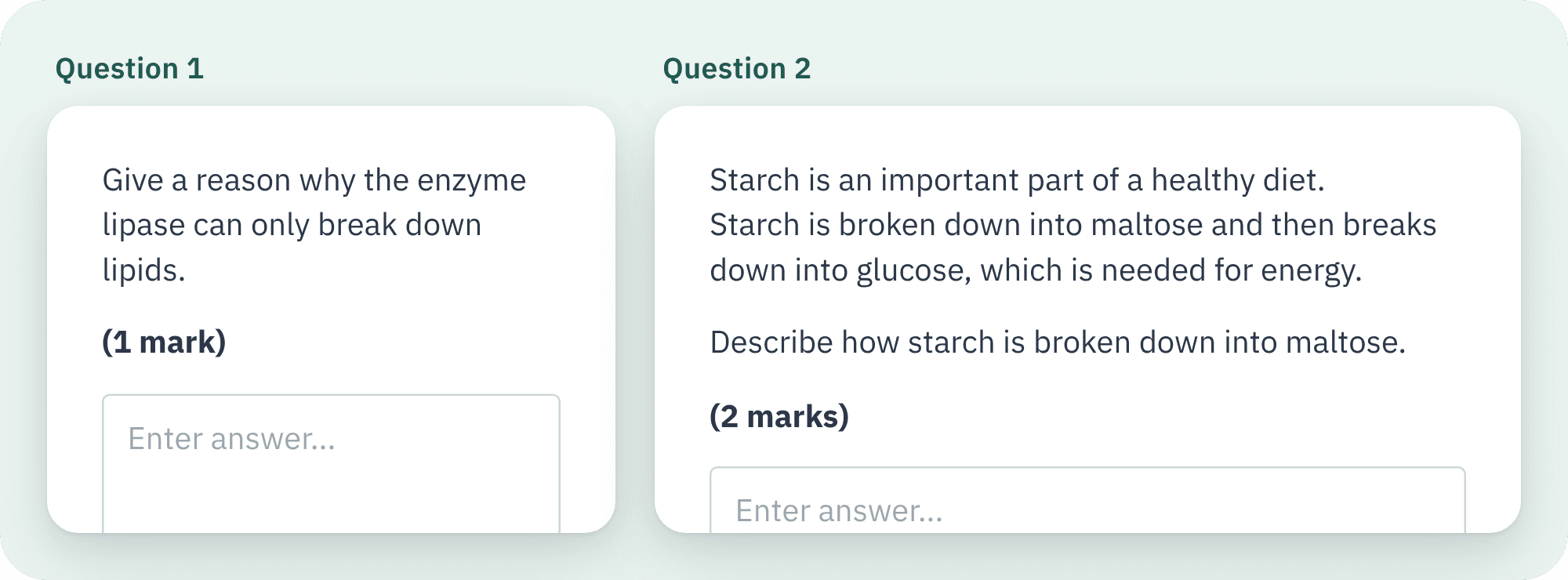
Students appear to be much stronger on these points. In Question 1 above, 76% of students were able to correctly state that the enzymes are specific to substrates, and in question 2, 93% are able to correctly identify that an enzyme is needed, but only 35% include a subsequent reference to starch binding at the active site. Again students are missing the key mechanism needed in these questions.
Taken together, these examples show how much can rest on the context of a question, and the command word given. Students might recognise the scientific idea, choose relevant apparatus or suggest a precaution, but still need to explain the link, specify the reading or match their response to the particular risk.
It is worth noting the Sparx Science questions are related to the exam questions, but are not replicas of them, so their percentages are not direct comparisons with exam results. What the responses do give us is a clearer view of the steps students leave out. That helps us make practice and feedback more precise, so students have opportunities to complete their reasoning and see what their answers still need.