

- Sparx Learning
Closing the gap: Turning insight into action for disadvantaged students
 Fay Sheppard- Education Director|November 18, 2025
After years of gradual progress, the disadvantage gap widened significantly following the COVID-19 pandemic. It's once again put disadvantage¹ back at the top of the agenda for schools, particularly in light of Ofsted’s new framework.
Closing this gap isn’t just an educational challenge, it’s a moral imperative. Doing so strengthens social mobility, boosts economic productivity and supports the wellbeing of entire communities. While schools play a central role, the effects of educational disadvantage reach far beyond the classroom. It shapes life opportunities, contributes to unemployment, lowers lifetime earnings and wider social inequality. Addressing it benefits every part of society.
Attendance unlocks achievement
It might seem obvious that attendance matters, but recent research (2025) on attendance from the Department for Education (DfE) shows how a small reduction in attendance can lead to measurable differences in attainment.
For teachers, it can feel counterintuitive to improve percentages that are already in the 90s. We often see numbers in this range and instinctively see a ‘good’ number, but in reality every decimal point below 100% counts. As the DfE notes:
“At primary school, children who attend school nearly every day in Year 6 (95-100% attendance) are 30% more likely to reach the expected standard in reading, writing and maths compared to similar pupils who attend 90-95% of the time. The link is even stronger at secondary school. Year 11 students with near-perfect attendance are almost twice as likely to achieve grade 5 in English and Maths GCSE, compared to similar students attending 90-95% of the time.”²
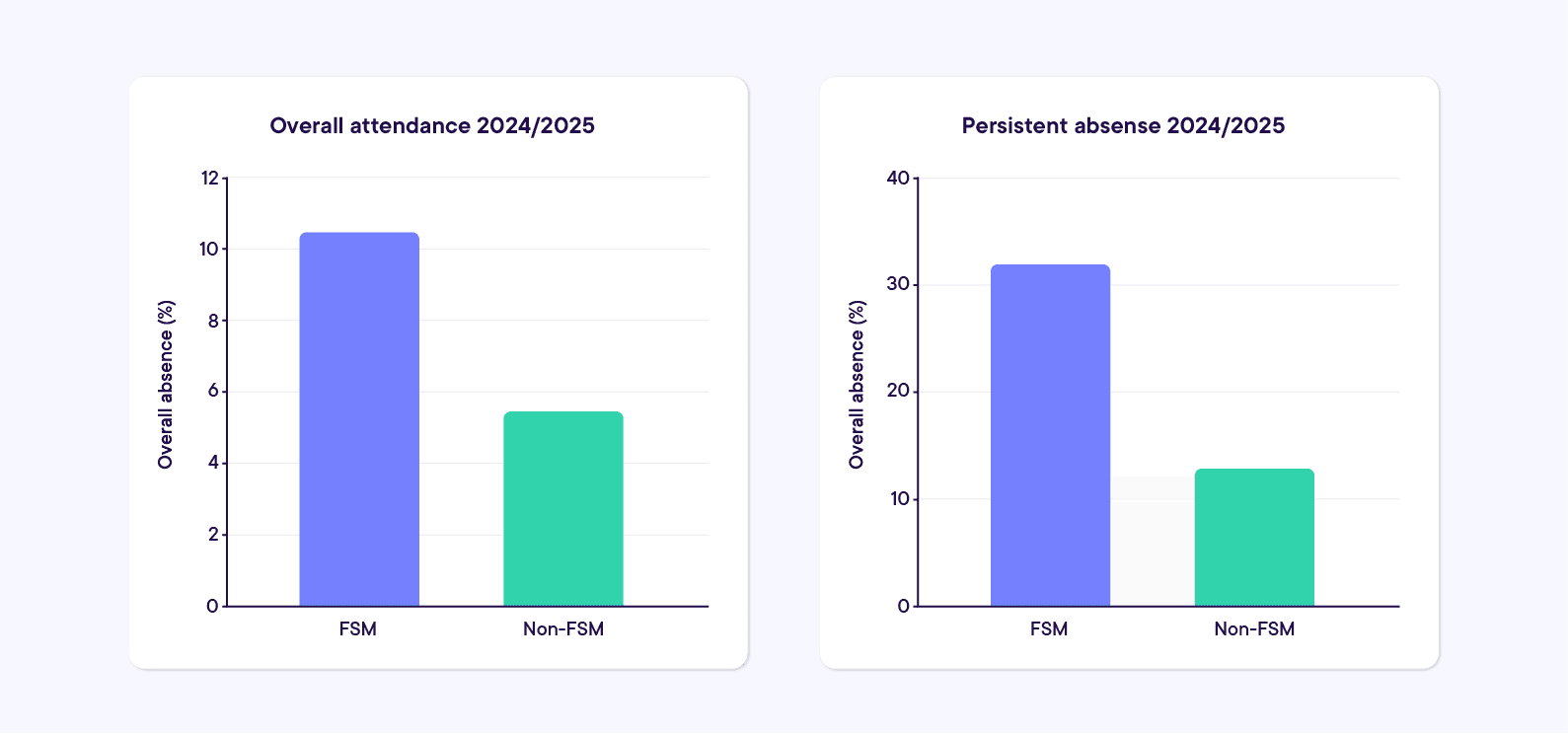
National data shows that disadvantaged students miss twice as much school as their peers. If schools are to start anywhere, it should be ensuring these students are in the classroom every day.
Growing up in disadvantage
Disadvantage doesn’t impact every part of the country equally. The Sutton Trust’s recent Opportunity Index³ highlights a stark North-South divide: the top 20 areas for educational opportunity are all in London, with East Ham ranked first.
This “London effect” means a child from a low-income background in parts of the capital has a far better chance of good grades and university entry than a similar child in some other regions.
These differences reflect a complex mix of factors - school quality, local economies, demographics, university outreach and investment. But one thing is clear, place matters.
For school leaders, that means benchmarking performance, not only nationally, but against schools in similar contexts. If others facing similar challenges are achieving more for disadvantaged students, what can we learn from them?
Growing up with a disadvantage - Early literacy and the “30 million word gap”
Disadvantage begins early. Research shows that by the age of three, children from higher-income families have been exposed to approximately 30 million more words than children from lower-income families.⁴ This staggering “word gap” isn’t just about vocabulary size; it reflects differences in early communication, enrichment and early learning experiences. Early years settings can help close that gap, by offering exposure to vocabulary.
However, unconscious bias⁵ can get in the way. Confident, articulate children often get more attention, leaving those with more need, less engaged. It’s not just the quantity of words that matters, but the quality of the conversation. It’s the conversational back and forth and questioning that boosts language development and even brain growth.⁶
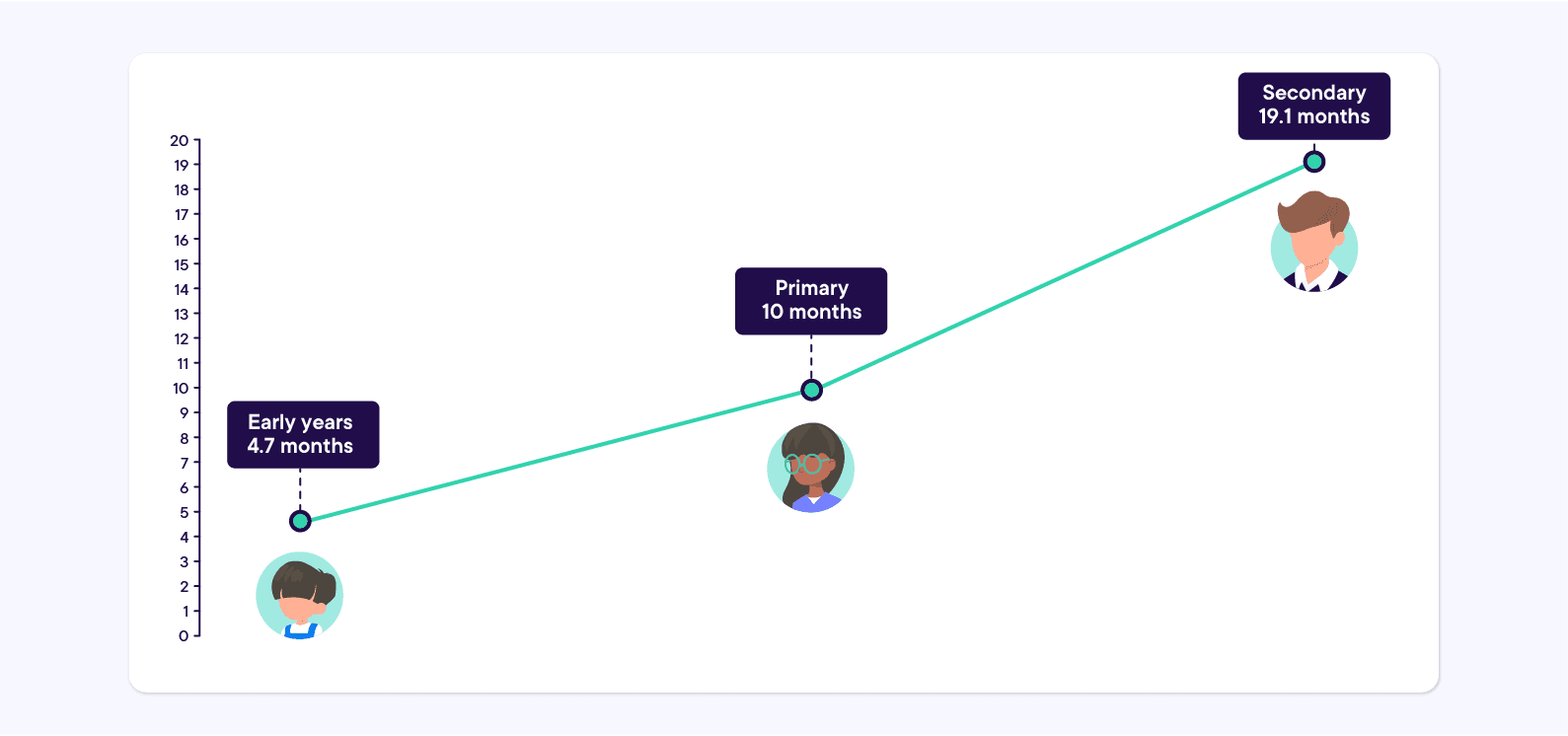
Language development is one of the most powerful levers we have to close the disadvantage gap early. A child with poor language skills at age five is about six times less likely to reach the expected standard in English and 11 times less likely in maths by age 11.⁷
By the end of Year 6 that gap doubles to around ten months, and by year 11, disadvantaged students in England are on average a year and a half to two years behind.⁸
However, we know that effective schools in some of the most deprived areas can and do achieve phenomenal outcomes. What sets them apart is strong culture, high-quality teaching, targeted support and a relentless belief that every student will succeed.
Transition to Secondary: The KS2-KS3 Dip
The move from primary to secondary is another critical phase. Research⁹ shows that high attainment at the end of primary education (particularly in maths) is one of the strongest predictors of later-life outcomes. Students who score higher in KS2 maths SATs go on to have significantly higher earnings in their 30s, even when their socio-economic background is accounted for.
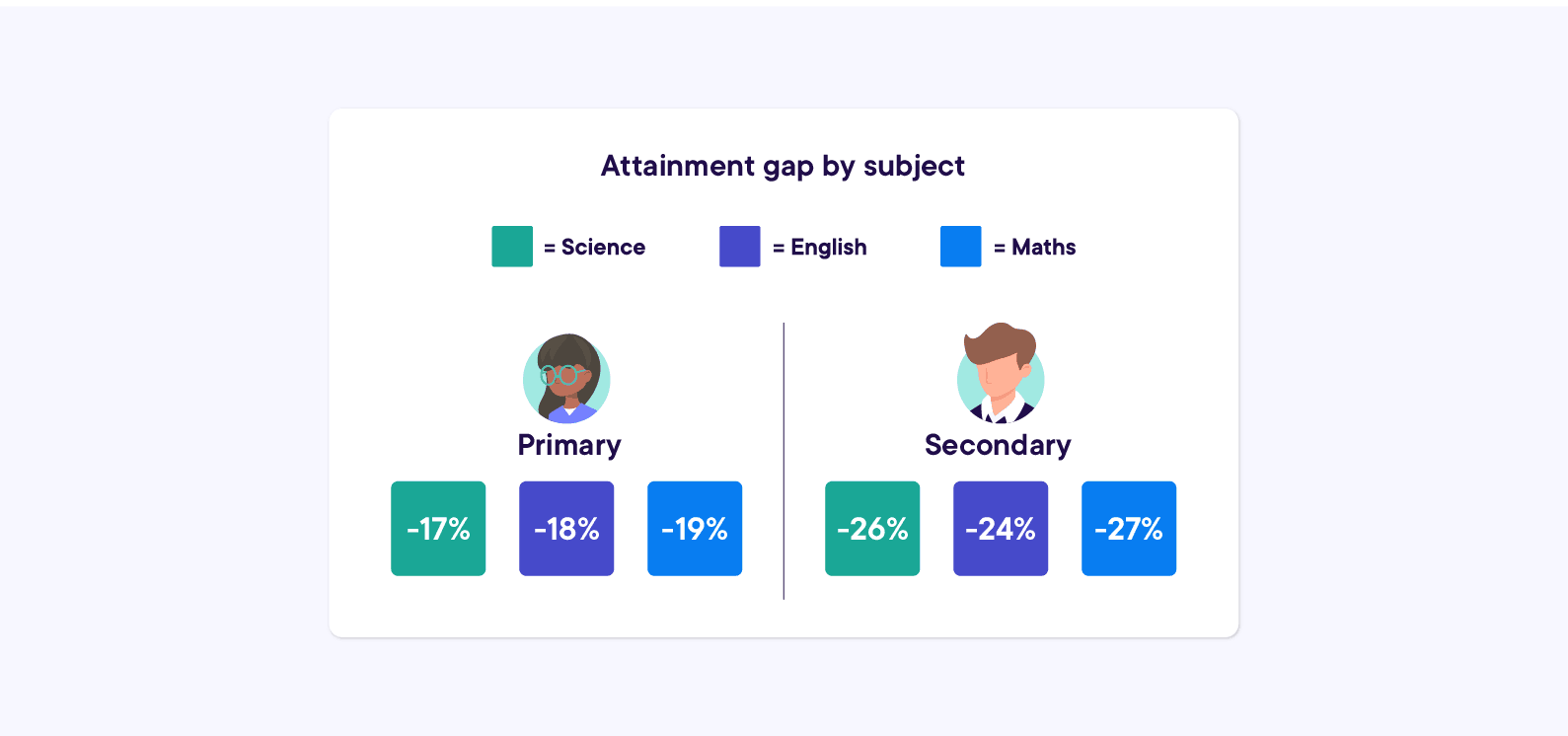
Unfortunately, too many high-achieving disadvantaged students lose momentum in KS3. Studies (including research by the Nuffield Foundation) shows that those who excel in KS2 often fail to maintain that trajectory through to GCSEs. By the time students reach GCSEs, the proportion of disadvantaged students achieving a Grade 4 is 26% lower for non-disadvantaged in science, 24% lower in english and 27% in maths. These outcomes mirror the picture at the end of primary school, where SATs results showed gaps of 17, 18 and 19 percentage points gap in science, reading and maths, respectively.¹⁰
Secondary schools can help change that. Identifying able disadvantaged students early in Year 7 and nurturing their ambition is vital. Even small interventions like sending congratulations and support packs to families can strengthen engagement and momentum.
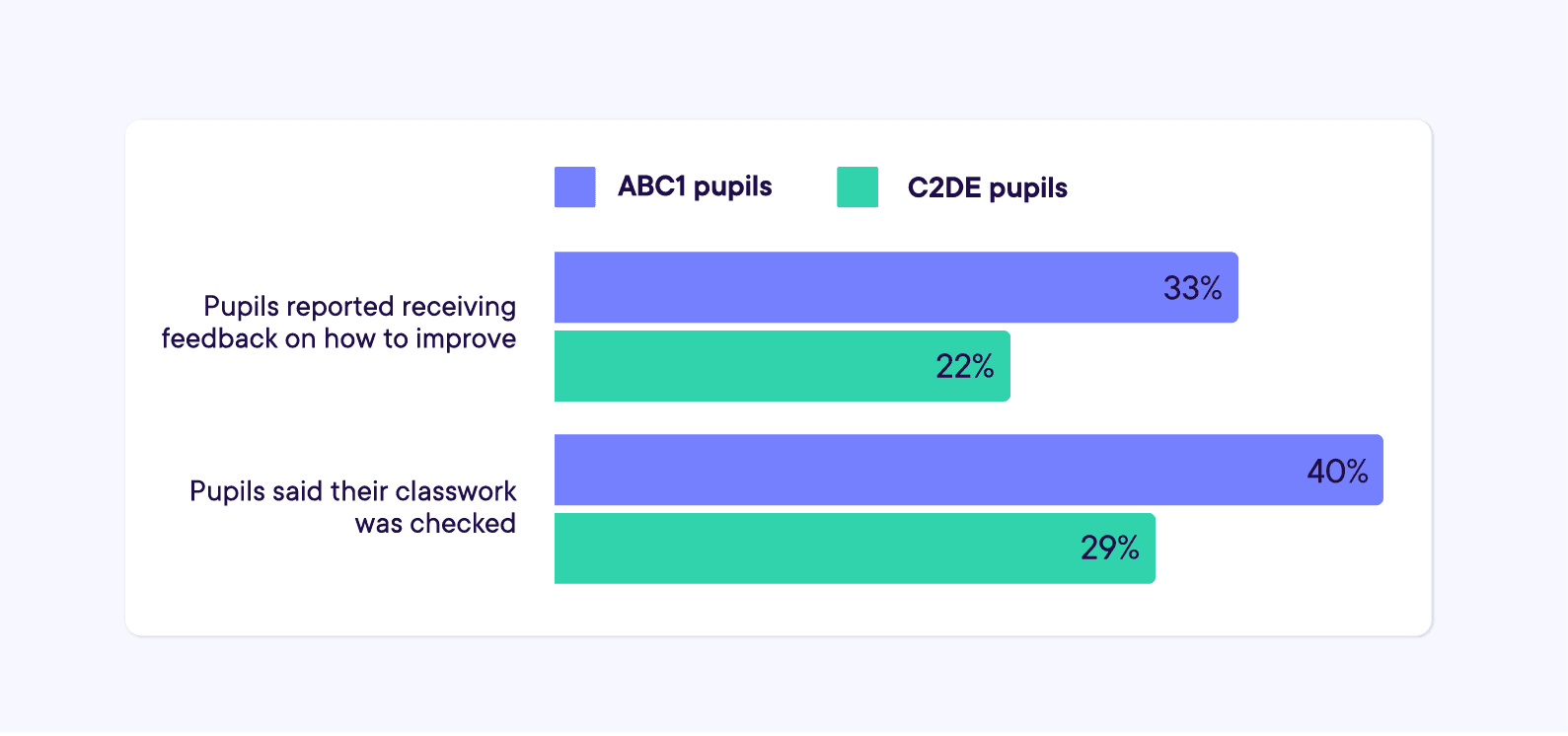
Recent research from UCL¹¹ shows that disengagement often sets in by the end of term 2 in Year 7 where disadvantaged students report feeling that their work was checked less frequently and they received less feedback.
To truly close the gap, our focus should be on Year 7 and 8 where engagement and ambition are being shaped and where early habits either build momentum or quietly erode it. This is the point at which students are forming their sense of belonging, confidence and academic identity and those early signals matter.
Practical steps for School Leaders
To conclude, we’ve brought together a set of practical, evidence-informed recommendations for school leaders. These actions draw on research and the experiences of schools that are successfully closing the disadvantage gap.
1. Focus on attendance - Set ambitious targets and intervene early:
- Create a welcoming classroom culture - greet students warmly and ensure they feel supported in lessons.
- Develop an attendance plan aiming for no gap between disadvantaged students and their peers.
- Act quickly when attendance drops, don’t wait for students to reach a PA threshold.
- Use mentors, breakfast clubs and check-in calls to build routine. Meet families in neutral spaces to build trust and engagement.
2. Ensure quality first teaching in every classroom:
- Invest in teacher development, especially in areas like teaching vocabulary, scaffolding for weaker readers, and formative assessment to identify misconceptions early.
- Use inclusive teaching strategies e.g. cold-calling.
- Double-check the understanding of disadvantaged students during independent work.
- Support departments to plan knowledge-rich, well sequenced learning that helps students revisit and retain ideas.
3. Use data to drive conversations:
- Make disadvantage a standing agenda item in department and pastoral meetings.
- Discuss attitude, attainment, homework completion, and reading ages.
- Make small, practical adjustments like:
- changing the seating plan to improve focus
- creating success moments to boost confidence
- scaffolding independent work to help students experience success.
4. Remove barriers to homework and independent study:
- Ensure all disadvantaged students have access to devices, stationery, revision guides and the internet - fund this using their Pupil Premium allocation.
- Offer homework clubs or catch-up sessions to provide a structured time and place to work.
- Monitor homework and intervene if early patterns appear - adjust policies and encourage attendance at support lessons.
5. Prioritise literacy and reading across the Curriculum:
- Make reading everyone’s business. Ensure teachers know reading ages and can support appropriately. Read aloud in a lesson. Consider adopting school-wide reading programmes like DEAR Time alongside targeted interventions for weaker readers.
- Promote oracy, classroom discussion and debate. Leverage Pupil Premium funding strategically.
- Invest in high-quality teaching, training, and targeted interventions.
- Consider one-to-one or small group tutoring led by academic mentors or teaching assistants to close learning gaps.
- Practical financial support can remove barriers to attendance (like uniform or travel). Monitor and track the impact from the start.
6. Talk about it:
- Encourage open, reflective discussions about disadvantage.
- Build a culture of constructive challenge:
- Yes, we have a homework policy, but are we monitoring whether disadvantaged students are completing it and what can we adjust if not?
- Yes, we know disadvantaged attendance is generally lower, but how are we supporting students to catch up on missed learning?
- Yes, all students can ask for help, but do our disadvantaged students feel able to?
¹ pupils who have been FSM-eligible at any point in the last six years or who are/were looked-after in care
² https://educationhub.blog.gov.uk/2025/08/why-school-attendance-matters-and-what-were-doing-to-improve-it/
³ https://www.suttontrust.com/our-research/the-opportunity-index/
⁴ Hart and Risley’s seminal 1995 study
⁵ https://www.gov.uk/government/publications/strong-foundations-in-the-first-years-of-school/strong-foundations-in-the-first-years-of-school
⁶ https://news.mit.edu/2018/conversation-boost-childrens-brain-response-language-0214
⁷ https://i.stci.uk/dam/early-language-development-and-childrens-primary-school-attainment.pdf-ch11234005.pdf/3avd35265cren41ss02q12fh7car5av2.pdf
⁸ https://epi.org.uk/publications-and-research/breaking-down-the-gap/
⁹ https://assets.publishing.service.gov.uk/media/6867d497fe1a249e937cbcdb/Key_Stage_2_attainment_and_lifetime_earnings_reseach_report_-_July_25.pdf
¹⁰ https://ffteducationdatalab.org.uk/2024/09/the-disadvantage-gap-at-key-stage-2-in-2024/
¹¹ https://axiommaths.com/blog/the-year-7-school-switch-off-by-spring/